
Authoradmin
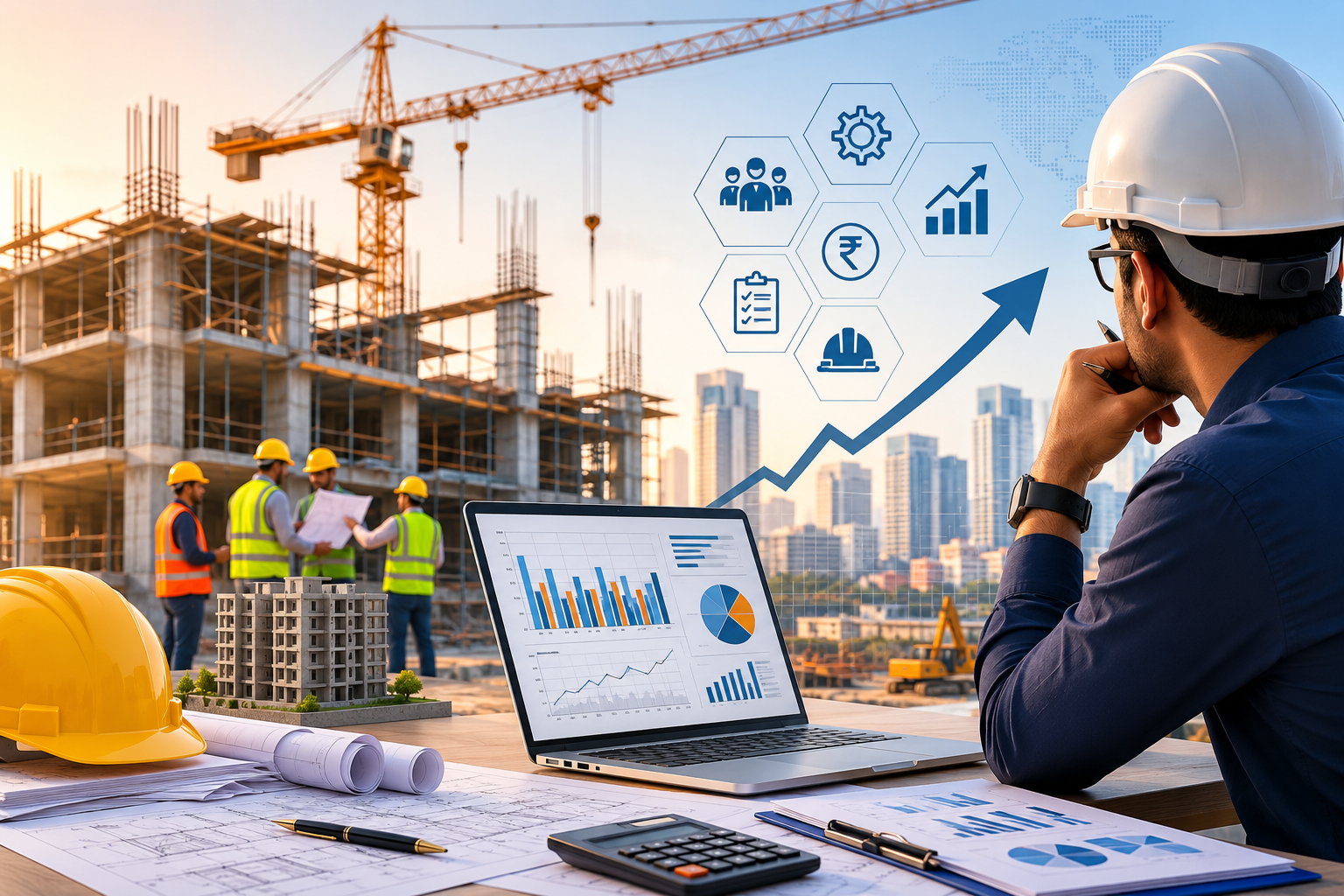
Construction businesses can generate significant revenue while still struggling with cash flow and shrinking profit margins. The reason is often not a lack of projects, but inefficient operations, poor resource utilization, rising overheads, delayed collections, and limited financial visibility.
Construction business profitability depends on more than winning tenders and completing projects. Contractors need to understand where money is being spent, how effectively manpower and equipment are being used, and how much working capital is tied up in ongoing operations.
A strong approach combines project-level cost control with better financial planning, resource management, and operational discipline. This is where professional Construction Business Consulting can help contractors identify inefficiencies and develop practical strategies for sustainable growth.
Many contractors naturally focus on three priorities:
These are important, but they do not provide the complete financial picture.
A project can be completed successfully while the overall business still loses money through idle labour, unused equipment, excessive overheads, inefficient purchasing, delayed collections, and poor cost tracking.
Construction businesses also face a unique cash-flow challenge. Money may be spent on labour, materials, equipment, subcontractors, and overheads well before payments are received from customers. The Construction Financial Management Association notes that construction companies need to monitor working capital and cash-flow projections because projects can require significant funding before cash is collected.
Profit leakage is often created by small inefficiencies that repeat across multiple projects.
One of the most crucial resources in construction is labor.When workers are waiting for materials, instructions, equipment, approvals, or the completion of another activity, the business may continue paying costs without receiving equivalent productive output.
Better manpower planning can help contractors match workforce requirements with project schedules and workloads.
Construction equipment represents a significant investment. Machines that remain unused for extended periods can increase ownership, financing, maintenance, insurance, and depreciation costs without contributing enough revenue.
Contractors should regularly review equipment utilization and compare ownership costs against actual project requirements.
Administrative expenses, office costs, software subscriptions, vehicles, management expenses, and other fixed costs can increase as a company grows.
The objective should not simply be to cut expenses. Instead, businesses should identify expenses that do not contribute sufficient operational or financial value.
Waiting until the end of the month—or worse, the end of a project—to understand financial performance can make corrective action difficult.
Timely reporting allows management to identify cost overruns, collection problems, budget variances, and resource inefficiencies earlier.
Working capital is the financial cushion that supports day-to-day operations. In construction, it can be tied up in receivables, work in progress, materials, retention amounts, and other current assets.
A business may appear profitable on paper but still experience financial pressure if customer payments arrive later than supplier, payroll, or project-related obligations.
Start with a rolling cash-flow forecast that tracks expected:
Review the forecast regularly rather than treating it as a one-time financial exercise.
The U.S. Small Business Administration also emphasizes the importance of understanding the difference between revenue, profit, and cash flow and using cash-flow projections to identify potential shortages before they become serious problems.
Review outstanding invoices by customer, project, age, and expected collection date.
Clear billing procedures, accurate documentation, milestone-based invoicing where appropriate, and consistent follow-up can improve the timing and predictability of collections.
Effective Construction Cost Management begins before the project starts and continues throughout execution.
A reliable process should connect the original estimate with the project budget, actual expenses, progress, and expected final cost.
Project Management Institute resources describe cost management as a process involving estimating, budgeting, monitoring, forecasting, and controlling project costs.
For each project, track major cost categories such as:
The question “How much have we spent?” is not the only one that matters.
“Are we spending according to the value of work completed, and what will the final project cost be?” is a better question to ask.
Earned value techniques can also help project teams compare planned work, completed work, and actual costs to identify cost and schedule problems earlier.
Construction Operational Efficiency is closely connected to profitability.
Even when sales increase, inefficient processes can consume the additional revenue through higher manpower requirements, coordination problems, rework, excess overhead, and project delays.
A practical operational review can examine:
The purpose is to identify where time, money, and resources are being consumed without creating proportional value.
Every project should have its own financial performance dashboard.
At minimum, contractors should monitor:
This allows management to identify which projects are genuinely profitable and which ones are consuming disproportionate resources.
Project cost-management research published by PMI highlights the importance of comparing planned costs with actual performance and using cost information to support corrective decisions.
Contractor Profit Optimization is not simply about reducing expenses. It is about improving the relationship between resources, revenue, costs, and profitability.
For example, imagine a contractor has ₹1 crore in active working capital. If an illustrative 15% of that amount becomes tied up because of inefficient operations, the blocked amount would be ₹15 lakh.
That does not mean every contractor experiences a 15% leakage rate. The actual percentage varies significantly by company, project type, payment terms, resource structure, and operating model.
The important lesson is that even a relatively small percentage of trapped capital can become financially significant at scale.
That capital could otherwise support:
Increasing revenue is only one part of business growth.
A company taking on more projects without improving its systems may experience greater coordination complexity, higher overheads, increased working-capital requirements, and greater financial risk.
Sustainable growth requires the business to build systems that can handle additional project volume without allowing costs and inefficiencies to grow at the same rate.
This is where Construction business profitability Consulting can provide value. An experienced consultant can review financial performance, operational processes, cost structures, and resource utilization to identify areas where the existing business model can be strengthened.
Nazareth Business Solutions provides business consulting, financial management, costing, strategic management, operational efficiency, and risk-management support. The company states that its director has more than 38 years of experience across financial accounting, costing, management accounting, strategic management, and related advisory areas.
Its business strategy services include operational efficiency and process optimization, financial discipline and cost management, performance management, and risk management. Its Accounts & Finance services also cover financial planning, cost optimization, cash-flow management, financial risk management, and financial reporting.
For construction and project-based businesses, this type of structured review can help management move beyond simply asking how much revenue the company generated and instead understand how effectively that revenue is being converted into sustainable profit.
Contractors can begin with a simple monthly review:
Consistency is more important than complexity. A simple reporting system reviewed regularly can be more useful than a sophisticated system that management rarely uses.
Construction business profitability is ultimately determined by how effectively a company manages its people, projects, cash, equipment, costs, and decision-making processes.
Winning more contracts can increase revenue, but sustainable growth requires strong operational and financial control behind that revenue.
The opportunity may already exist within your current business—in unused capacity, delayed collections, excessive overheads, inefficient resource allocation, or weak project-cost visibility.
If you want to understand where your business may be losing cash or profitability, Nazareth Business Solutions can help you review your financial and operational processes and identify practical areas for improvement.
Visit Nazareth Business Solutions to explore professional business consulting and financial management solutions.pro


0 Comments
Your email address will not be published. Required fields are marked *